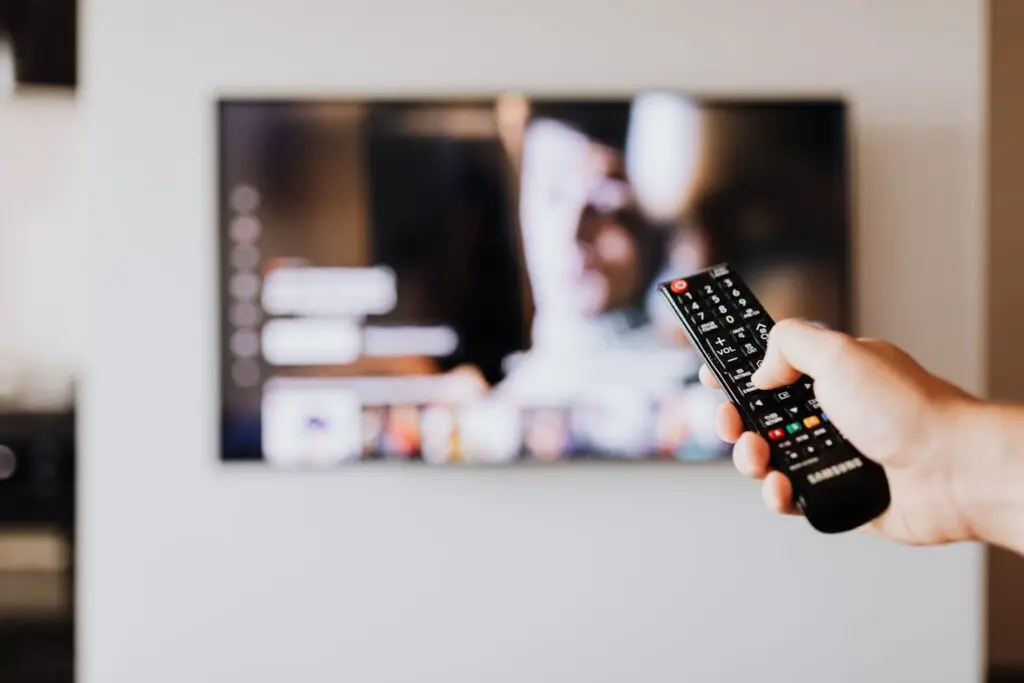
The kids have gone to bed, the wife and I have sat down to unwind and “quickly watch something.”
Forty-three minutes later, we will have:
- Rejected 12 dramas
- Auditioned 7 documentaries
- Betrayed 3 rom-coms
- Watched one trailer twice
- Started something
- Stopped it after 8 minutes
- And finally whispered, “I’ll just watch The Office again.”
We just participated in one of the largest ongoing behavioral experiments in human history: The Streaming Choice Paradox. Please don’t congratulate us.
Let’s break this down like responsible market researchers who absolutely did not give up and rewatch Parks and Rec for a sixth time.
Act I: The Browsing-to-Watching Ratio (BWR)
In the Golden Age of Television (also known as “When You Had 42 Channels and Liked It”), your choice architecture was simple:
- What’s on?
- Is it terrible?
- Fine. I’ll watch it.
Today, the average streaming platform offers thousands of titles. Thousands. That’s not a catalog. That’s a psychological obstacle course that, by the time I’m ready to unwind, my brain is in no way prepared for.
From a market research standpoint, what we’re seeing is a classic case of choice overload. When options increase:
- Perceived control increases.
- Satisfaction initially increases.
- Then cognitive collapse sets in.
In theory, more choice = more happiness. In practice, more choice = “Why is everything bad?”
We’ve essentially gamified browsing. You are no longer watching content. You are:
- Evaluating thumbnails.
- Judging fonts.
- Reading 3-word descriptions like they’re sacred texts from Mark Twain himself.
- Whispering “hmm” repeatedly like a confused sommelier.
We now spend 15–20 minutes browsing for something we’ll abandon in 10. From a research lens, that’s a Browsing-to-Watching Ratio (BWR) of 2:1.
In any other industry, this would be chaos.
Imagine going to a restaurant and reading the menu for 40 minutes, ordering, taking one bite, and saying, “Actually, now that I’ve tasted this, I think I want noodles.”
That restaurant would ban you.
Streaming services encourage it.
Act II: Decision Fatigue: The Brain Is Tired, Jessica
Market research has long shown that decision fatigue is real. The more decisions you make throughout the day, the worse you get at making them.
By the time you open Netflix, you’ve already chosen:
- What to wear
- What to eat
- Which emails to ignore
- Whether that Slack message needed a smiley face
Your prefrontal cortex is running on fumes and a red wine blend.
Now the algorithm presents you with:
“Because you watched one cooking show in 2017, here are 42 emotionally devastating chef documentaries.”
Your brain, already exhausted, responds with:
“Nope. I cannot be responsible for another decision.”
So you scroll. And scroll. And scroll.
From a behavioral standpoint, what’s happening is fascinating:
- Too many options → cognitive strain
- Cognitive strain → fear of picking the wrong option
- Fear of regret → extended browsing
- Extended browsing → lower eventual satisfaction
Ironically, the more time we invest in choosing, the more we expect the content to justify that investment.
Which is why 8 minutes into a show we think: “I spent 20 minutes finding you. Now, impress me.”
That’s not entertainment. That’s a performance review.
Act III: The Comfort Rewatch Phenomenon
And then… we snap. “I’ll just watch The Office again.” Market researchers call this risk minimization behavior.
Normal people call it: “I don’t have the emotional bandwidth for a new plot.”
Comfort rewatches are the sweatpants of streaming. Predictable. Safe. Zero cognitive overhead.
Why does this happen? Because uncertainty is mentally expensive.
When you rewatch:
- You already know the characters.
- You know there are no surprise tragedies.
- You know exactly when the funny part happens.
- You don’t have to evaluate whether you’re “wasting” your evening.
It’s guaranteed ROI.
From a data standpoint, this is gold. Streaming platforms know that a huge portion of viewing hours comes from repeat content. Familiarity drives engagement more reliably than novelty.
Which means the industry spends billions producing new content…
…so we can rewatch Season 3 of something from 2009.
In research terms, this is called: The Nostalgia Stability Loop.
In human terms, it’s: “I would like to see Jim break the fourth wall and look at the camera again.”
Act IV: Thumbnail Economics & The Illusion of Optimization
Here’s where it gets even funnier (and slightly dystopian).
Streaming platforms run constant A/B tests:
- Different thumbnails for different users
- Slight title variations
- Genre categorization experiments
- Trailer auto-play strategies
Entire teams analyze:
- Scroll velocity
- Hover time
- Abandonment rate
- Episode completion percentage
All to answer one question: “How do we get them to stop scrolling?”
Meanwhile, you are on your couch thinking, “Why is everything meh?”
This is the paradox of modern market research: we can optimize discovery to the millisecond. But we cannot eliminate existential indecision. Because the issue isn’t content quality. It’s cognitive saturation.
When options are infinite, satisfaction becomes super fragile.
Act V: The Psychology of “Maybe There’s Something Better”
There’s another sneaky force at play: anticipated regret.
When you choose something, you are not just selecting a show.
You are eliminating all other shows.
What if:
- The next one was better?
- The next one was funnier?
- The next one changed your life?
Streaming has weaponized FOMO.
In classic consumer research, this is tied to maximizer vs. satisficer behavior:
- Maximizers want the best possible choice.
- Satisficers want a good-enough choice.
Streaming turns all of us into maximizers at 9:36 PM on a Tuesday.
We don’t want “good.” We want “I have optimized my very limited leisure time.”
Which is absurd, because 80% of the time we’re half-scrolling our phones anyway. I digress.
Act VI: What This Teaches Us About Market Research
This tiny, relatable behavior reveals big truths about consumer psychology:
- More choice does not equal more happiness.
- Cognitive load directly affects satisfaction.
- Familiarity often beats novelty.
- Optimization can’t fully fix emotional friction.
- People don’t always want better; they want easier.
And perhaps most importantly: consumers are not rational utility-maximizing machines. They are tired. They just want something that doesn’t feel like work.
The Last Word
We laugh at the 15-minute browsing ritual. But it’s a microcosm of modern consumer life.
We comparison-shop everything. We read reviews for toothbrushes we’ve bought multiple times before. We optimize for 4.7 stars. We fear suboptimal decisions.
Then we use muscle memory to navigate the remote in the dark so we can rewatch a sitcom for the 10th (or 11th?) time.
Maybe the solution isn’t more personalization. Maybe it’s fewer choices. A “Just Press Play, I Trust You” button.
Or a streaming platform that says: “You’ve had a long day. Here’s something comforting. No thinking required.”
Until then, we scroll. We hover. We judge thumbnails like art critics.
And eventually… “I’ll just watch The Office again.”
And the more I think about how good seasons 1-7 were… That’s probably the right choice.
***
SMARI is an award-winning Indiana-based market research consultancy that was founded in 1983 with the idea of guiding change and inspiring confidence. We are proud to work with both SMEs and a variety of Fortune 500 brands. We are powered by our core values: integrity, community, perseverance, trust, passion, curiosity, and innovation. SMARI’s expertise spans full project scopes, including instrument design, sampling & fielding services, and reporting & analysis across Healthcare, CPG, Retail, Food & Beverage, Manufacturing, and Financial Services industries, and beyond. Much has changed in our 40+ years, but our tagline and overarching mission remain the same—to guide change and inspire confidence. Start a conversation with us at www.SMARI.com.